

What Are Ways To Clean Oil Out Of Water
JUNE 17, 2015 -- Whether for hanging a picture on the wall or fixing a leaky faucet, virtually people keep a common set of tools in their home. While some tools go more use than others, information technology'south good to take an array on paw to handle most repair jobs. The same is true for responding to oil spills.
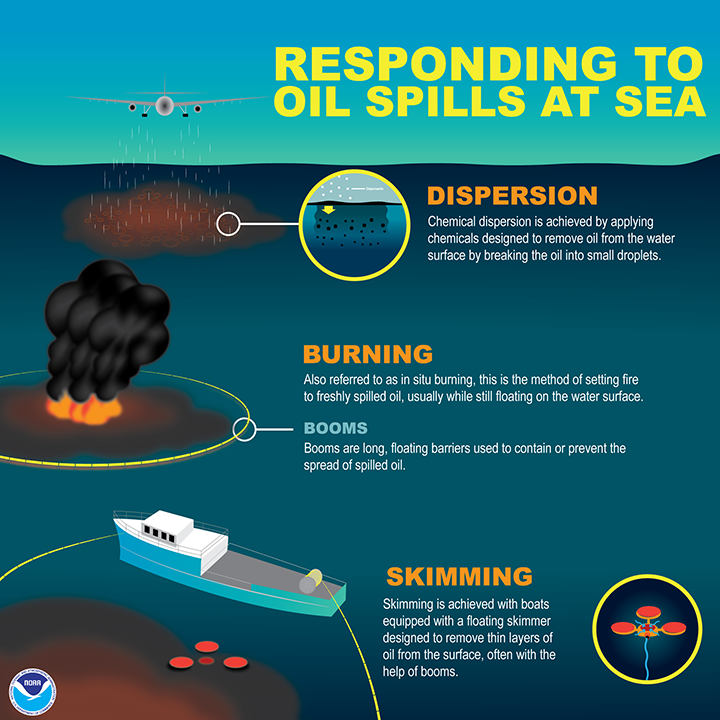
Similar a home repair chore, each oil spill has unique aspects that call for careful consideration when deciding which tool to use. Responders keep an array of response methods in their toolkit for dealing with oil in offshore waters: skimming and booming, in situ burning, and applying dispersants.
Let'southward get to know a few of those tools and the situations when they might be the near advisable method for dealing with oil spills out at sea.
Skimming: Take a Little off the Meridian
Skimming is a process that removes oil from the sea surface before it reaches sensitive areas along a coastline. Sometimes, two boats will tow a collection blast, allowing oil to concentrate within the blast, where information technology is then picked upward by a "skimmer." From whirring disks to floating drums, skimmers come in various designs only all basically work by removing the oil layer from the surface of the h2o. These devices attract oil to their surfaces before transferring information technology to a collection tank, often on a gunkhole. Ideal conditions for skimming are during the day when the oil slick is thick and the ocean surface is adequately at-home.
The success of a skimming operation is dependent on something known as the "encounter rate." Much like a vacuum picks up dirt from your carpet, a skimmer has to come in direct contact with the oil in society to remove information technology from the surface and, even then, information technology will all the same pick upward some water. That's why responders volition often refer to the volume of oil removed via skimming as gallons of an oil-water mixture.
In Situ Burning: Burn After Oiling
In situ burning is the process of burning spilled oil where information technology is on the ocean (known as "in situ," which is Latin for "on site"). Similar to skimming, two boats volition ofttimes tow a fire-retardant drove smash to concentrate enough oil to fire. Burning is sometimes as well used in treating oiled marshes.
Ideal conditions for in situ burning are daylight with mild or offshore winds and flat seas. The success of burning oil is dependent on corralling a layer of oil thick enough to maintain a sustained fire. Whatsoever burn operation includes careful air monitoring to ensure smoke or residue resulting from the burn do not adversely impact people or wildlife.
Chemical Dispersants: Interruption It Up
Releasing chemic dispersants, usually from a small airplane or a response vessel, on an oil slick breaks downward the oil into smaller droplets, allowing them to mix more easily into the water column. Smaller droplets of oil get more readily available to microbes that will swallow them and suspension them downward into less harmful compounds.
Nonetheless, using dispersants has its drawbacks, shifting potential impacts to the marine life living in the water cavalcade and on the seafloor. Considering of this, the decision to chemically disperse oil into the h2o column is never made lightly. This determination is frequently fabricated so that much less oil stays at the surface, where it could affect birds and wildlife at the body of water surface and drift onto vulnerable coastal habitat similar beaches, wetlands, and tidal flats.
Ideal conditions for chemical dispersion are daylight with balmy winds and moderate seas. Chemic dispersion is never washed close to the shore, in shallow waters, near coastal communities, or when there is a potential for winds to carry the chemical spray away from its intended target.
Natural dispersion can and does occur when waves at the bounding main surface have enough turbulent energy to allow surface oil to mix into the water column. Applying chemical dispersants can expedite this process when at that place is an imminent threat associated with assuasive the oil to stay on the surface.
Click to view larger. (NOAA)
One Size Does Not Fit All
Y'all may have noticed that each of these tools has one common factor limiting its effectiveness: daylight, or more than precisely, visibility. Being able to see the spilled oil, oftentimes over large areas of the ocean, is critical to being able to clean information technology up. That means these tools get ineffective at dark, during sure seasons, or in regions where prolonged darkness, fog, or clouds are the norm.
| Sunlight? | Windy? | Rough Seas? | Cold? | Nearshore? | |
|---|---|---|---|---|---|
| Skimming | Yes | Perhaps | No | Yes | Yes |
| Burning | Yes | Peradventure | No | Yes | No |
| Dispersing | Yes | No | No | Yes | No |
Rough seas can exist prohibitive for skimming and burning since these methods rely on calm conditions and collection booms to gather (and proceed) oil in one place. Loftier winds tin often rule out burning and aerial dispersion as an pick.
While these techniques perform all-time under certain, ideal conditions, responders often have to make exercise with the variety of conditions going on during an oil spill and can and do use these tools under less-than-ideal conditions. Their effectiveness also depends on factors such as the blazon or country of the spilled oil or the environs it was spilled in (e.g., sea ice).
Just similar your home repairs, the job sometimes calls for a non-traditional tool or artistic ready. The connected development of alternative response methods and technologies for cleaning up oil is critical for addressing oil spills in geographic areas or conditions that the traditional toolbox is not equipped to fix.

Source: https://response.restoration.noaa.gov/about/media/how-do-oil-spills-out-sea-typically-get-cleaned.html
Posted by: cainsinve1953.blogspot.com
0 Response to "What Are Ways To Clean Oil Out Of Water"
Post a Comment