

How To Clean Up A Voice Recording In Audacity
When you're dealing with audio files, you'll run into a few problems every so soften. This is particularly true with voice recordings and sound that was converted to a digital format from a cassette record or a vinyl tape.
1 of the biggest issues is noise. This could exist hissing or groundwork noise like the sound of the wind or a loud air conditioning unit, or even someone inadvertently breathing into a microphone. No matter what the source is, that noise is distracting. And while it'south hard to eliminate all of the noise from a digital sound recording, information technology is possible to clean the file upwards so that the noise tolerable.
A swell manner to do that is with Audacity. In this article, I expect at how to clean up digital audio using the Linux version of Audacity. The techniques work equally well with the Windows and Mac OS versions of the software, too.
Enter Audacity
Audacity is an open up source audio recorder and editor that enables you to record, modify, and consign sound files.
While Audacity is powerful and fairly easy to use, information technology'due south not quite a professional person-level tool. There'southward a lot Audacity can do, but in that location's just equally much that information technology can't do. Afterwards using Audacity to work on your audio files you shouldn't look the quality of audio you get from a store-bought CD or a high-quality digital download. The results will, however, be more than acceptable for most purposes.
Getting started
If you don't have a copy of Audacity installed, download it or install it using your distribution'south package manager. Since MP3 is arguably the dominant digital audio format, chances are yous'll be working with MP3 files almost exclusively. Audacity doesn't accept built-in support for MP3s. Yous can add that support by downloading and installing an open source audio encoder called LAME. When used in conjunction with software like Audacity, LAME enables the software to import and export MP3 files that are of a high quality.
In Audacity, select File > Import > Sound. Detect the audio file that you lot want to clean upwardly and and then click OK. Here'southward what raw sound looks like in Audacity:
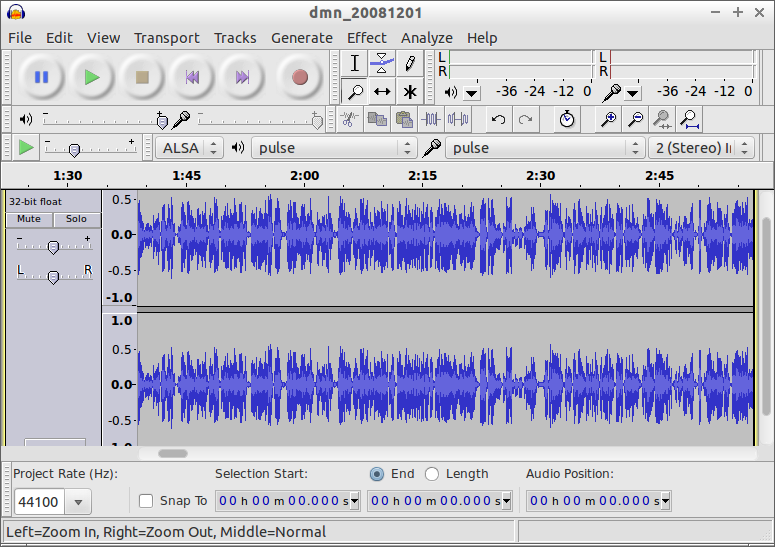
Notice that the audio is represented by a fix of densely packed vertical lines called a waveform. The longer portions of the waveform are louder than the shorter portions. This becomes important afterwards.
Listen to some or all of the audio before editing the file. This gives you an idea of the quality of the recording, and helps yous plan how to edit the file. It besides helps you identify the portions of the file that need to be cleaned up.
You can get adept results using the following two-stage process:
-
Removing noise
-
Evening out the loud and soft portions of the audio
Removing the dissonance
Audacity has a swell built-in noise reduction tool. To get information technology to do its job properly, you lot need to get your easily a bit dirty. So, first you need to go a noise profile which lets Audacity recognize what noise in the file actually is. The profile gives Audacity a baseline from which to piece of work. To get a good noise profile, yous need to find a section of the audio file in which there's no talking. This appears as a apartment line in Audacity. Several seconds worth of expressionless air is all-time. If you don't accept that much, use what yous can.
Click and drag to highlight the racket. So, select Result > Noise Removal. Click Get Noise Profile.
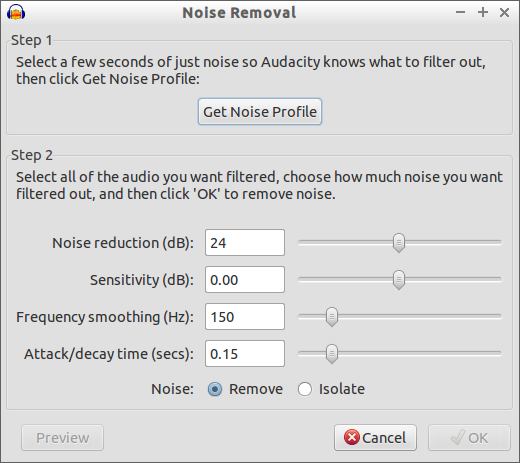
Depending on the size of the noise sample that yous selected, this can take anywhere from one to several seconds.
Highlight the entire sound file by pressing CTRL+A on your keyboard. Select Outcome > Noise Removal again. Move the sliders to the left (for less) or the correct (for more than), depending on how much noise you desire to remove. Click Preview to test your pick.
If yous move the sliders too far to the correct, you get a noticeable echo. While the echo replaces the noise that you lot're trying to eliminate, it'due south annoying too. With many audio files – specially ones that are merely voice recordings – moving the sliders slightly left of middle works all-time.
When you lot're satisfied that you've chosen the correct settings, click Remove Noise. Over again, depending on the length of the audio file the racket removal process tin can have anywhere from a couple of seconds to up to twenty seconds.
Click the Play button on the toolbar to test the racket level by playing the entire file. Retrieve that what you do isn't permanent. If the result isn't what you expected, undo it past pressing CTRL+Z on your keyboard. So, repeat the noise removal process with unlike settings.
At the end of the racket removal phase, you'll discover that much (if not all) of the dissonance is gone. Any's left probably isn't that annoying or distracting. You lot can clean the file even more than using a utility called the Compressor.
Evening out the sound
Most audio files don't have a uniform volume. There are sections that are louder than others. Audacity can even out the loud and soft sections with its Compressor utility. The Compressor looks at the louder and softer portions of your sound file and then lowers the volume of the louder $.25 while not touching the softer portions.
To utilise the Compressor, first highlight the department of the file containing the audio that you want to fifty-fifty out. Then, select Effect > Compressor.
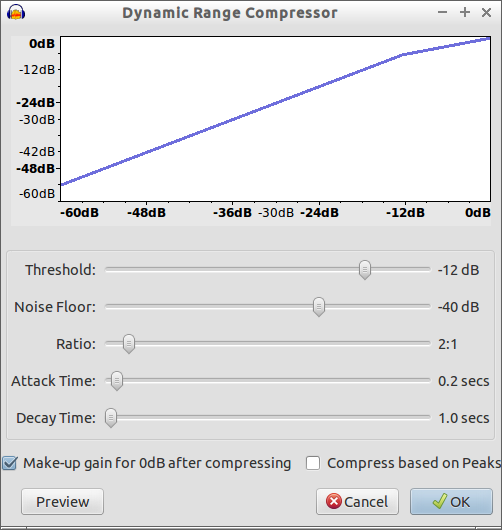
The Compressor dialog box looks intimidating, but in one case yous get going information technology's adequately easy to use. Focus on the Threshold setting. The threshold is the maximum amount of volume that the Compressor volition tolerate. The threshold is measured in decibels (db). Whatever bit of audio that is louder than the threshold has its volume reduced.
You should set a threshold somewhere betwixt the loudest and softest parts of your audio. So, if the loudest part is -7db and the softest is -13db, then you should set a threshold of -10db. Set the threshold by clicking and dragging the Threshold slider.
Next, look at the Ratio setting. This sets the level of compression. Commonly, the default of 2:ane is good enough for most recordings. There will be times when a higher ratio, similar 3:ane, might be meliorate. I've never had whatsoever reason to fix the ratio higher than four:1.
Go out the Assault Fourth dimension and Decay Fourth dimension setting equally they are. Too, exit the Make-upward gain for 0db after compressingselection checked. This will slightly increase the overall volume of your recording and, in many cases, assistance alleviate whatever sound drop outs.
Click the Preview button to test whether or non y'all chose the correct settings. When yous're gear up to go, click OK. Again, the compression process takes several seconds, depending on the size of the file.
Equally with the dissonance removal process, test the compression by highlighting the section you just compressed so clicking Play. Yous tin can undo your edits by pressing CTRL+Z. Then, repeat the pinch process with different settings.
Going dorsum to MP3
One time yous're satisfied that enough of the noise has been removed, salve the audio every bit an MP3. Select File > Consign. Then, cull MP3 files from the listing of file types and select the folder on your computer in which you want to save the file.
Summing up
You'll need to experiment with Audacity and its tools in order to go the results that you desire. It takes a flake of piece of work, but you'll quickly come up with a set of settings and remedies that work for you.
Recollect that no ii audio files are alike. With each new file that y'all're cleaning upwards, you'll need to tweak the settings that you lot use.
While Audacity isn't a professional tool, it is a great pick for most audio cleanup tasks. With a little practice, you volition become quite skillful at using it to brand your audio files sound better.
A version of this article was published at the Geeks.com's Tech Tips blog (December, 2006). Reposted here via a Creative Commons.

Source: https://opensource.com/life/14/10/how-clean-digital-recordings-using-audacity
Posted by: cainsinve1953.blogspot.com
0 Response to "How To Clean Up A Voice Recording In Audacity"
Post a Comment